
If your child is having trouble paying attention in dance class or has a tough time making good choices when the dance teacher gives instructions, there are things you can do as a parent to encourage and help your your young dancer listen in dance class.
Below we’ll look at the structure of a preschool dance class and what is appropriate for your young dancer.
Consider the class material.
Ballet is a discipline that cannot and should not truly be practiced until a child is around 7 years old. The maturity, physically and mentally, of a child under 7 is not developed enough for the barre work and technique required for ballet.
Most dance studios teach a mix of creative dance, movement games, and some fundamental ballet postures and ideas in their preschool classes.
Some studios pay too little attention to child development and getting that “mix” right for their youngest students. For example, the children may spend a lot of time in lines or standing in one spot, or the dance teacher may not vary her tone of voice or set clear limits/expectations for the children, or the kids are asked to focus on one thing for longer than they are yet able. Some children have a disposition that allows them to just “hang in there”, even when they are bored or under-stimulated. Some children do not. The repetition and extended focus that is a solid teaching method for students only a few years older is very hard to tolerate for preschool dancers.
Preschool children do best when…
- Things move quickly,
- There is a lot of variety,
- Their imaginations and creativity are fully engaged,
- Dance is packed with learning that feels (and looks) like PLAY.
Dance at this stage should have a clear structure with emphasis on creativity and interpersonal or classroom skills. Its focus should be creating thinking dancers and the development of problem solving, movement (direction, body and spatial awareness) and motor (jumping, galloping, kicking) skills. Greater emphasis on technique and choreography comes later when children begin to advance and increase their dedication to the discipline of dance study.
Consider the dance teacher’s experience and style.
A qualified teacher works well with and has experience teaching young children.
- Experience – Way too often, classes for a dance school’s youngest children are given to the school’s most inexperienced teachers. There are many reasons this happens but those who work best with little children have usually had great mentors and a lot of opportunity to observe and lead dance classes for young children.
- Style – Experience is not everything. Therefore, also consider the way your child’s teacher interacts with students, how he/she develops a relationship with your child, how your child feels about the class, and what you’ve seen of the teacher’s methods and teaching style. Watch carefully. At this age, your child’s response and learning in dance is more important than the skills and choreography he/she accomplishes.
Every child is different and every teacher is too. If you feel your daughter is losing interest or having trouble listening because the class structure or teacher is not a good fit, you might try out other classes. This will allow you to observe how your child reacts in an alternative setting.
Remember that a child may simply respond more positively to a different style, and an improved result does not necessarily mean that the previous teacher or school used poor or inappropriate methods.
Maybe dance just isn’t right for my child…
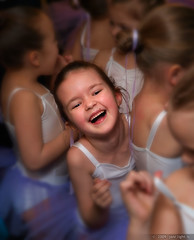
Whether or not your child will have a desire to continue in dance when the focus IS more on technique and choreography is hard to predict. No matter what, the experience in a preschool dance class can be invaluable for helping to prepare a young child for school and other activities.
Laying a solid foundation for a future in dance begins with discovering a joy and passion for movement. So if that’s what lies ahead for your little dancer, these feelings are what will carry him or her through the difficult periods of training which students inevitably face as they advance.
If your young child is struggling to make good choices in dance class, don’t give up on dance until you’ve done some problem solving at home and with your child’s teacher.
![Reblog this post [with Zemanta]](https://img.zemanta.com/reblog_c.png?x-id=3b304b32-57ac-46b2-8389-5371a0a7270b)


Nichelle Suzanne is a writer specializing in dance and online content. She is also a dance instructor with over 20 years experience teaching in dance studios, community programs, and colleges. She began Dance Advantage in 2008, equipped with a passion for movement education and an intuitive sense that a blog could bring dancers together. As a Houston-based dance writer, Nichelle covers dance performance for Dance Source Houston, Arts+Culture Texas, and other publications. She is a leader in social media within the dance community and has presented on blogging for dance organizations, including Dance/USA. Nichelle provides web consulting and writing services for dancers, dance schools and studios, and those beyond the dance world. Read Nichelle’s posts.