Teachers and parents both want self-esteem to grow in a child.
The goal is to build confidence in a healthy way so that kids can better deal with the every-day adversities and challenges that life brings. Often, parents and teachers take action by providing children with plenty of praise, accolades, and awards.
But, is there such a thing as too much praise? Is it possible for praise to backfire? How can one instill confidence without creating a dependence on external approval?
Too Much of a Good Thing?
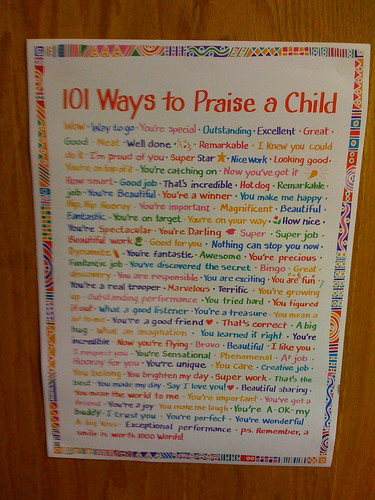
Most experts seem to agree that empty praise like “Good job!” or “You’re awesome!” is ineffective because children recognize that these statements are not always accurately or sincerely offered. It has been found that students praised for being smart are less motivated to achieve than those appreciated for working hard. They believe their intelligence to be unchangeable rather than something that can be improved upon, in turn affecting their performance:
“Kids who get too much praise are less likely to take risks, are highly sensitive to failure and are more likely to give up when faced with a challenge.” – Why Praise Can Be Bad For Kids, ABC news
As you can see, because of such findings, it has often been surmised that too much praise can be a bad thing (as noted in the quote above). However, similar outcomes might also apply in students who are continually criticized. So is too much praise really the problem or is it something else?
Descriptive and Appreciative vs. Evaluative
A statement is evaluative any time we use “good,” “poor,” or “excellent” to label a person, skill, or effort. Assigning a judgment tells the dancer how they should feel about themselves or what they did. Faced with continuous evaluation (be it positive or negative) by others, a student begins to depend on this feedback for forming opinions about themselves (self-approval/disapproval).
Evaluative Statements provide only temporary results. Sooner or later a student will find they cannot live up to your assessment. They may try to prove you wrong or, become discouraged, remembering all the times they weren’t “great” or “sweet,” or, feel disappointment any time their pirouettes are not deemed “wonderful.” Children labeled as “good” at something are less likely to discover exactly what their strengths or weaknesses are and therefore cannot build upon these things. Their improvement may slow or stop altogether or, they may focus only on this area, striving for more approval.
Why Do We Evaluate?
There are many reasons we fall into a cycle of evaluative praise or judgments. One, it’s easy and requires little thought. Another, more subliminal reason is because it creates dependency. It makes our opinions about what is good or bad matter and encourages the student to conform to our ideals, keeping us in a position of authority.
Be More Specific
Professionals in the field of education encourage teachers and parents to be specific when offering praise and, to avoid labeling children. Recognizing that students respond better when the focus is on the effort or work involved, it is presumed that the type of praise, not the amount, affects performance and motivation. “Your pirouettes look great!” is more specific than “Great job, Alison!” “Brooke, you’re spotting really well.” is clearer still. Even more effective, because it focuses on the work involved, might be something like “Hayden, you’ve been working hard on your alignment at the barre. Your pirouettes look wonderful!”
However, consider the power of a statement that avoids evaluating even the skill itself and, instead, simply describes and appreciates their accomplishment. For instance:
EVALUATIVE — “Hayden, you’ve been working hard on your alignment at the barre. Your pirouettes look wonderful!”
DESCRIPTIVE — “Hayden, thank you for working so hard on your alignment at the barre. Your turns have really improved!“
Descriptive and Appreciative Praise may seem unnatural or more cumbersome at first. It is likely that you will occasionally find yourself offering an evaluative statement – don’t be too hard on yourself! As you know, practice is key to forming positive habits and change. Like the comment to Hayden above, many times only a slight change is needed to make a remark more descriptive and less evaluative. It won’t take long until you’ve mastered the technique!
Here are some simple guidelines:
- Use “Thank you for…” instead of “Good job.” to show your appreciation for their work/attitude.
- Describe specifically what you see, hear, or feel – “Your spotting was really crisp and clear.” vs. “You’re a great turner.” or “Your comment to Jill hurt her feelings.” vs. “What a mean thing to say!”
- Stick to the facts about how you feel – “When you talk in class, I feel frustrated that I have to talk over you to be heard. It concerns me that you won’t hear what I have to say.” vs. “It is really rude to talk while I’m talking. You obviously don’t care about your dancing.” (I, I, I instead of you, you, you)
- Present a bigger challenge – “Now, try a triple pirouette!” vs. “Excellent double!” This works for a negative, too. If the students are spinning like tops but not maintaining their turnout, congratulate them for getting a quadruple, but add, “Can you keep your legs turned out and still do the quad?”
- Avoid labeling – “Thanks for helping me put away the props!” vs. “You are so sweet!” or “I don’t appreciate your tone.” vs. “Alright, Ms. Attitude, that’s enough!”

With your conscious effort to select words that are encouraging without being controlling, that focus on the deed not the doer, your students will be able to form their own opinions about themselves, their actions, and abilities. By fostering, rather than fashioning their healthy self-esteem, your students can feel secure, capable, and supported and will become more confident and responsible as a result.
Further Reading
- Praise That Builds a Child’s Self-Esteem
- Why Praise Can Be Bad For Kids
- Montessori Classroom – Descriptive and Evaluative Praise
- Can Adults Praise Children Too Much? (some alternative opinions presented here)
Practice some Descriptive Praise right now!
- List three things that you might want to praise your students for in your next class.
- Then, select ways you might state your praise descriptively.
- Look for opportunities to use the phrases you’ve prepared/practiced in your next class.
Be sure to list your three phrases below in the comments so that others can see some more great examples!
Let us know if you use or try this technique in class and share your results or thoughts!


Nichelle Suzanne is a writer specializing in dance and online content. She is also a dance instructor with over 20 years experience teaching in dance studios, community programs, and colleges. She began Dance Advantage in 2008, equipped with a passion for movement education and an intuitive sense that a blog could bring dancers together. As a Houston-based dance writer, Nichelle covers dance performance for Dance Source Houston, Arts+Culture Texas, and other publications. She is a leader in social media within the dance community and has presented on blogging for dance organizations, including Dance/USA. Nichelle provides web consulting and writing services for dancers, dance schools and studios, and those beyond the dance world. Read Nichelle’s posts.