Muscles 101: Comparing muscles to a rubber band might be stretching it….
July 19, 2010 by Lauren Warnecke
Filed under Blog, Technique, Toolbox, Wellness

Teachers often use the image of a rubber band to describe muscles. When you stretch a rubber band, it usually returns to its normal size; if you continuously pull it beyond the maximum that it can be stretched, the rubber band stays stretched out. Using this metaphor, if you continuously stretch your muscles beyond their maximum range of motion (ROM), eventually they will stay stretched out…..
Sort of.
Muscles have two main jobs: generating power and responding to “perturbations”.
The rubber band/muscle metaphor is great in describing the body’s response to perturbations (such as the bus moving forward when you’re not ready for it, someone handing you something that you think is heavy but is actually light, being bumped into, etc). In these instances, a reaction called the stretch reflex recoils muscles that have been stretched as a result of a perturbation. In the example of standing on a bus that moves when you’re not expecting it, you’ll notice that you lean forward and then right yourself. If the muscle is stretched too far, the muscle can’t recoil and instead you are forced to take a step forward to prevent from falling.
Try this: Stand up with your feet under your hips and eyes closed. You’ll notice that you sway forward and back slightly. In order to help you maintain balance, your brain triggers muscle action in the calf and ankle when you start to pitch forward, righting your stance . This is the stretch reflex in action (in combination with structures in the inner ear that control balance).
While the image of a rubber band is useful in demonstrating the elastic nature of muscles in the stretch reflex, it’s not always as simple as the stretch/recoil and stretch-farther/less-recoil that we gain from thinking of muscles simply as rubber bands.
I’ll explain, but first, a brief anatomy and physiology lesson:
How do muscles work?
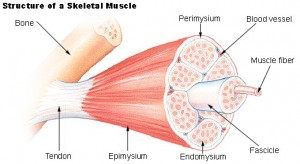
A muscle is built of bundles of lots and lots and lots of muscle fibers bundled together by a sheath called the sarcolemma. One muscle fiber contains lots and lots and lots of myofibrils, and one myofibril contains two types of myofilaments (thick and thin). This is where the magic happens.
The brain sends a signal (a neural impulse called an action potential) to the muscle that says “Hey muscle! Contract!” Through a complex series of chemical reactions, proteins on the thick and thin filaments bond to one another and create energy in a chemical form. The chemical energy is converted into a mechanical (tensile) force that generates power to move bone. Every time you point, jump, bend, etc. your body goes through the same brain-muscle-bone loop called Excitation-Contraction Coupling (in case you want to look it up on Wikipedia) and it all happens faster than you can snap your fingers.
Wow. That’s amazing. And not at all like a rubber band.
Apart from this complex process, there are a number of variables that impact muscle behavior, such as temperature. Warming-up increases the body’s core temperature and also helps breaks any leftover bonds (what I refer to as “crunchiness”) that might be hanging around. As mentioned in my previous post, Is It Okay To Stretch Before Class?, stretching before activity has a short-lasting (acute) effect on range of motion, but the effect of stretching is maximized if you are warmed-up. Warming up also increases the amount of power a muscle can produce, making movements more efficient.
Think about this: What would it feel like to do grand allegro first in a ballet class? I don’t care to find out, but you can imagine that your ability to produce power, and therefore height, in your jumps is much better at the end of class when your muscles are warm. Muscles also react differently when they are sore, strained or fatigued and all of these topics are complicated enough to deserve their own posts, so I won’t delve into them here…
More than anything else, I want to emphasize that rubber bands don’t have brains. The key point in all of this is that you have a brain, and that your brain drives everything that happens in your muscles. It senses unexpected events and recoils muscles back into place. It sends neurological impulses to muscles, causing a series of chemical reactions, producing energy that is converted into force that makes you move. I said it once, and I’ll say it again:
That is amazing.
Reference: Enoka, R. M. Neuromechanics of Human Movement, 3rd. edition
Is It Okay To Stretch Before Class?
June 17, 2010 by Lauren Warnecke
Filed under Blog, For Career Dancers, For Everyone Else, For Juniors, For Students, Performance, Technique, Toolbox, Wellness
Is stretching part of your ritual?
While I was a dance major, I had a very strict routine that consisted of getting up at 6:00am, making coffee in my leotard, driving to school by 7:30am (to grab my super secret parking space in downtown Chicago), and entering the studio for morning ballet class before anyone else had arrived. The sun would peak through the windows creating a beautiful, peaceful place for me to be alone without the distraction of other dancers, teachers or fluorescent lights. Five days out the week I followed this routine, and without fail the first thing I would do is lay down on the ground, stick my feet over my head and stretch.
I never gave much thought at that time as to whether or not stretching before class was beneficial. It is just something we dancers do. We arrive early (never on time) and stretch. Many ballet teachers give a warm-up or stretching exercises to the class before even beginning the barre. I remember being told as a young dancer “you must be fully warm before you ever do your first plie.” You feel that morning crunchiness in your joints, the little tug in your hamstrings, and just “stretch it out.”
To stretch or not to stretch?
The idea of stretching before physical activity is not unique to dance. I recall those days of P.E. where we would all stand and stretch together before going to play whatever sport was featured that day. In fact, studies performed as recently as 1989 have declared stretching to be “essential” in preventing injury and enhancing performance by increasing the elasticity and range of motion (ROM) of the muscle (1). It is by this presumption that we came to believe that you must stretch before completing any sort of vigorous physical activity, and this opinion is still held by a great many P.E. and dance teachers, not to mention personal trainers, physical therapists, sports physicians and athletic coaches (2).
More recent research has questioned the commonly held belief that stretching before activity is beneficial to performance and prevents injury. In fact, there is some evidence to suggest that stretching can have detrimental effects on performance, and may even INCREASE the risk of injury…
But aren’t there different ways to stretch?
There are five major types of stretching: static, dynamic, proprioceptive neuromuscular facilitation, ballistic stretching, and eccentric lengthening. For the purpose of this article, we can work with the two most common forms of stretching (static and dynamic). You may see both types in your dance classes or do them on your own. The other types of stretching are usually employed in a therapeutic setting with the help of a clinician. Here’s a summary of the difference between the two types:
STATIC STRETCHING
Now, let’s assume that you aren’t lucky enough to be one of those hyper-flexible Gumbi-type dancers that can walk into a studio cold and plop down into the splits. That is a whole other issue that carries its own set of benefits and challenges. Instead, you are a dancer of average flexibility. You have no problem extending to 90-degrees, and once you are warm you can easily accomplish the splits and higher extensions. However, when you first enter the studio, you feel that pinch and that crunch. In the traditional thinking, you are like me: the dancer who comes in early to sit on the floor in a straddle, or plow, or forward bend until the pinch slowly begins to ease and feel less pinch-y. This type of stretch is called static—where you choose a position at the end of your ROM (range of motion) that targets a particular muscle, and hold it.
DYNAMIC STRETCHING
Dynamic stretching is a series of or active motions that increase joint ROM and stretch the muscles more passively than static stretches. Examples include leg swings (or balancoire), grand battement, and arm swings. Some people believe that this is a more natural way to stretch and increase your range of motion, and it simultaneously warms the body. Dynamic stretching is rather trendy right now because it somehow fulfills our moral obligation to stretch and isn’t uncomfortable like static stretching.
So, can I stretch before class, or can’t I?
That depends on the goal…
If you are stretching with the goal of long-term changes in your flexibility (for example, you can’t do the splits and would like to), save your stretching routine for after class or between barre and center when your muscles are “warm.” See more about this in Nichelle’s post about Stretching Safely For Splits.
Generally speaking, both of the stretching techniques above have acute (short-lasting) effects on your range of motion before activity, but don’t really increase your overall flexibility.
If you are stretching to chase away the “crunchiness,” there isn’t really any reason to believe that stretching before class can hurt you, but then again, it doesn’t necessarily help you either. Stretching doesn’t inevitably mean that you will not be sore or will be less sore (3). Some researches have found that pre-stretching might result in a small decrease in muscular strength and power, and this may be of importance to elite dancers requiring exceptional strength and endurance, but there is no current evidence suggesting that stretching while cold leads to injury (3,4).

- Image by stevendepolo via Flickr

- Image by stevendepolo via Flickr
Bottom line:
Ultimately, if stretching feels good, then stretch. If it’s part of your morning routine or class-time ritual, then do it. Just take care…
- Stretching should never hurt.
- Don’t reach past your natural range of motion unless your body is completely warm.
- If you find that static stretching is very uncomfortable for you, try some dynamic stretches.
Your body is a complex series of chemical and mechanical processes, and while we imagine that muscles are as simple as stretching a rubber band, there is a lot going on in there that is still not fully understood by scientists. But for more on muscles, you’ll have to wait!
Next month: How do muscles work?
References:
- Safran, M.R., A.V. Seaber, and W.E. Garrett, Jr., Warm-up and muscular injury prevention. An update. Sports Med, 1989. 8(4): p. 239-49.
-
Shehab, R., et al., Pre-exercise stretching and sports related injuries: knowledge, attitudes and practices. Clin J Sport Med, 2006. 16(3): p. 228-31.
- Herbert, R.D. and M. Gabriel, Effects of stretching before and after exercising on muscle soreness and risk of injury: systematic review. Bmj, 2002. 325(7362): p. 468.
- Thacker, S.B., et al., The impact of stretching on sports injury risk: a systematic review of the literature. Med Sci Sports Exerc, 2004. 36(3): p. 371-8.
Oversplits – Overdoing It?
December 7, 2009 by Nichelle (admin)
Filed under Blog, Featured, For Students, Toolbox, Wellness

- Image via Wikipedia
In my post my last post, Stretching Safely for Splits, I promised to go into more detail regarding my thoughts on oversplits. If you aren’t familiar, these are splits that go beyond 180 degrees (above the hips) and are usually achieved by stretching in a split with the legs supported by pillows, blocks, or chairs. I’ll reiterate that I don’t feel that there is anything wrong with working to achieve oversplits. There are healthy ways to go about striving for or achieving this level of flexibility. There are also a few things that I think students should consider before beginning a regimen that will get them there.
Are they necessary?
With all the emphasis on flexibility it may feel as though an oversplit is your only answer to achieving a beautiful grand jeté or pencheé. However, dance requires a moving, active flexibility. While oversplits (or splits in general) increase your range of motion, they do not improve strength and stability. Often when students are struggling to execute these moving splits, they may have sufficient flexibility but lack control. An oversplit is not much good to someone who is missing crucial pieces of the puzzle. Take even a portion of the time and energy directed toward stretching and flexibility and replace it with conscientious application of technique during class. Moving through your range of motion in practice is the best preparation for achieving the leaps and pencheé of your dreams. Without good placement, attention to line, stability, and power, all you’ve got with an oversplit is a parlor trick.
Are they worth it?
If anyone has conducted specific research on the joint/muscle health of gymnasts or others who specifically train and work oversplits, I’d love to hear your thoughts! Based on my understanding of joint health, there is greater potential for damage to joints, ligaments, and tendons when it comes to oversplits. This is especially true if you are “hanging” in the split from two raised surfaces – this is not a healthy way of achieving your goal and I cringe whenever I see it. It is extremely important that someone working toward oversplits spend equal (if not more) time on strengthening and stabilizing the hips and core of the body. If you ignore signals that you are pushing too hard or too far, you may be hindering or halting any current progress you’ve made in your flexibility. You may even be sacrificing joint stability and overall joint health, perhaps ending your career early or causing problems later in life… for a few measly degrees.
“Once a muscle has reached its absolute maximum length, attempting to stretch the muscle further only serves to stretch the ligaments and put undue stress upon the tendons (two things that you do not want to stretch). Ligaments will tear when stretched more than 6% of their normal length. Tendons are not even supposed to be able to lengthen. Even when stretched ligaments and tendons do not tear, loose joints and/or a decrease in the joint’s stability can occur (thus vastly increasing your risk of injury).” – runtheplanet.com
“When muscles are stretched beyond natural voluntary ranges of motion, the muscles and tendons are stretched unnaturally. Excessive stretching damages tissues and promotes inflammation” – Yang, Im, & Wang, 2005
Are they desirable?
In many ways an oversplit could be considered an asset. Remember though that most dancers aspire to more than just moving through a series of static positions (at least I hope they do). They aim to convey and communicate as well as wow or inspire. Choreographers have this same aim when they create dances and in most cases would prefer a dancer who can offer more than just incredible flexibility. Even audiences want more from their dancers – after the initial “wow” wears off, especially. So, I’ll repeat that an oversplit is not much good to someone who is missing crucial pieces of the puzzle like performance, strength, intelligence, artistry, technique. I’ll also mention that there are those, particularly in classical ballet, that find overextended leaps, arabesques, etc. downright incongruous with the aesthetics of the art form and dislike seeing these slip into the choreography. While removing limitations in range of motion can free the body for expression, it is important to show restraint and mindfulness in displaying this kind of freedom.
What Do You Think?
Do you like to see dancers utilizing this skill onstage?
How do you feel about dancers (recreational, pre-professional, or otherwise) training for oversplits?
Some folks utilize the power of gravity for oversplits. I’ve shared my view on this. What do you think? Is there a “right” way and a “wrong” way to stretch for oversplits?
Stretching Safely for Splits
November 19, 2009 by Nichelle (admin)
Filed under Blog, Featured, For Students, Toolbox, Wellness
Can you do “the splits?”
Splits are a topic on most young dancers’ minds. I know when I was a student the ability to sit in a split seemed pretty important. Of course, flexibility and range of motion are certainly fundamental elements in dance. However, when it comes to stretching and splits some dancers place intense emphasis on achieving the ideal static position, forgetting that this type of flexibility is only part of the picture. They compromise the health of their instrument – the body – as they push to extremes to get results, and get results fast.
How fast is fast?
When it comes to stretching, “fast” is a very relative term. Online I’ve seen students inquiring how they might achieve a split over one weekend. Those offering branded stretching regimens that promise or imply fast results are usually talking weeks or months, but most correctly point out that results will vary depending on a number of factors. What are these variables?

- Image via Wikipedia
- Joint anatomy and physiology
- Elasticity of ligaments and tendons
- Gender – While a male has the same potential for flexibility as any female, differences in bone structure, muscle mass, and chemical make-up, often mean that women generally encounter fewer obstacles in achieving a certain level of flexibility or range of motion.
- Age – As with gender, the potential to perform a split is there no matter your age but flexibility declines in adulthood, meaning that maintaining or increasing the degree of pliancy requires more effort for an adult than a child.
- State of mind – Don’t write off the degree to which your mindset plays a part – science doesn’t. Discoveries and investigation continues to determine the brain’s role in stretching, and several flexibility programs directly address the issue.
As enticing as improving your flexibility over a period of a few days or weeks sounds, research tells us extreme stretching methods and overstretching can be counterproductive to gaining flexibility.
How?
A mechanism called the stretch reflex sends signals to a stretched muscle, causing it to contract in order to limit lengthening and protect the muscle from tears. Entering a split too swiftly or aggressively strengthens the contraction, working against gains in flexibility (this is one reason ballistic stretching or bouncing is discouraged). Instead, easing into and holding a stretch is recommended. This maintains the length in the muscle to a point that it “gets used to” the increased length and respond by reducing the level of the reflexive contraction.
So the longer, I hold it the better, right? Actually, holding a stretch for very long periods of time (several minutes or longer) can cause damage to connective tissues, as does stretching without warming up the body. This damage requires time to repair and will actually slow progress in improving flexibility.
Are oversplits safe? Nothing is inherently wrong with working toward oversplits… gradually, progressively, just as you would work at achieving other splits. However, I would suggest proceeding with even more awareness and care. See more on this in Oversplits… Overdoing It?
When Is the Right Time to Stretch?
I think it is pretty common knowledge among dancers these days that one should not stretch “cold.” However that habit of walking into a studio or green room and settling into our favorite stretch or straddle is a hard one to break. I’m guilty myself.
What you may not know is that there are different kinds or ways of stretching. A split is considered a static passive stretch, meaning you are holding a stretch using your body weight or some other external force (as opposed to a static active stretch, like lifting your leg in arabesque, during which the stretch is held using the agonist muscles). Rather than warming up with static passive stretching, I would recommended that you begin with dynamic stretching, performing movements that address a joint’s full range of motion. Some basic examples of dynamic stretching can be found here. These are a good starting point for a warmup but as dancer, your dynamic stretches may look more like leg swings or even variations of Bartenieff’s “X” series.
The best time for splits or other static passive stretches are after the body has been completely warmed up. After a class, for example.
What are some signals that I’m overstretching?
- If you’ve warmed up thoroughly and there is still pain, or
- If you experience muscle cramps or spasms, you may be stretching too aggressively.
- If you have pain during or immediately after the stretch, you may have a serious tear (you will usually feel some soreness from a minor tear the next day – if this occurs try to improve your warmup method). Tears usually result in some loss of flexibility. Light stretching can counteract this following a minor tear but be very careful not to overdo it.
- It may go without saying that if you hear a sound, like a pop, while stretching this is not a good sign. Stop immediately, follow the RICE method, and see a medical professional.
How Can I Get My Splits?

- Image via Wikipedia
The answer isn’t exactly cut and dry. Everyone seems to have their own method and below I’ll point you to just some of the freely available and anatomically aware advice online. There are paid programs too but I can’t vouch for any of these because I’ve not tried them. Plus there are plenty of books on the subject. I welcome your thoughts on any programs or resources you’ve tried!
Splits and Flexibility Resources
- How to Improve Your Flexibility Safely Into the Splits – Lisa Howell (Lisa also has a Front Splits Fast program)
- Stretching and Flexibility – Brad Appleton
- Working Toward The Splits – Atlanta Martial Arts
- The Beginner’s Guide to Flexibility – Martial Arts Planet forum
Safe stretching is a huge topic with sometimes conflicting research. I couldn’t possibly cover it all in one or even two posts. The advice above, I hope, will help you determine if your current method or one you are exploring is a reasonably safe and healthy way to increase flexibility. Be wary of “too good to be true” claims and YouTube demonstrations from fellow students, please!
Introducing the Iliopsoas
October 13, 2009 by Nichelle (admin)
Filed under Blog, Featured, For Career Dancers, For Students, Technique, Terminology, Toolbox, Wellness
- Image via Wikipedia
Ladies and Gentlemen, children of all ages!
It is my particular pleasure to introduce to you, the iliopsoas, a thrilling group of three muscles which are exquisitely fundamental to the function of the hip joint. As an indispensable stabilizer of the lumbar spine and pelvis, and the one and only muscle group that has within it a sufficient power to flex the hip joint and lift the leg above, with appropriate amazement, 90 degrees, it seems a gloriously gigantic understatement to call this muscle merely important. It is clear this wondrously complex muscle group not only deserves but demands your supremely scrupulous attention. I am outstandingly overjoyed to dazzle your eminently esteemed self with the following…
Okay, sorry to get all Barnum & Bailey on you. I promise the rest of this article won’t be nearly as dramatic.
Some of you, I would bet, have never even heard the term iliopsoas (ill-ee-oh-so-az) before. Meanwhile others of you have teachers who are devoted advocates for these miracle muscles but perhaps you still have questions. I’m going to try to answer some of the basic ones.
Why is the iliopsoas important?
- The iliopsoas has a profound influence on alignment of the pelvis. Because of this it has a great affect on posture and coordination in dance. A dancer that moves smoothly and efficiently is utilizing the strength and stability of their center or core, of which the iliopsoas is an essential component.
- The iliopsoas is the primary hip flexor for the leg when it is above 90 degrees. The coveted “extension” of professional dancers is powered (in part) by these mighty muscles.
- The iliopsoas can be a source of injury in dancers who repeatedly perform movements which flex (crease) the hip joint. Strains in the lower back, snapping hips, and leg pain are known outcomes to an imbalance of movement patterns which can be caused when a dancer compensates for a tight or weak iliopsoas.
Let’s get something straight, through. The muscles which make up the iliopsoas play an important role in a few crucial components of dance. While increasing your awareness, understanding, and proper use of these muscles can have enormous benefits, please note that the muscles of the hip, pelvis, spine and upper leg are complex. No single muscle group could possibly be the root of or solution to all of the issues that arise in these areas. With guidance from a teacher who has a firm grasp on the power and function of this muscle group, however, your increased awareness has the potential to lead to those wonderful “ah-ha” moments which can change your dancing.
What and Where is the Iliopsoas?
The iliopsoas is the only muscle (well, technically group of muscles) that attaches to the spine, pelvis, and femur (or, thigh). There are three muscles which make up the iliopsoas. The iliacus, the psoas major, and the psoas minor.
Though it has some involvement in the “lifting” of the pubic bone to correct alignment, the psoas minor has been found to be absent in a large percentage of people (a bi-product it seems of our more sedentary lifestyles). The major players are the psoas major and iliacus. Psoas major is attached to multiple points along the lower spine. It then meets up with the iliacus, which is attached to the illiac fossa (For reference, when you put your hands on your

- Image via Wikipedia
“hips” you are placing them on the crest or upper rim of the ilium. The iliacus attaches to the inner, concave surface of this large, bony structure). The muscles then cross the front rim of the pelvis and the hip joint to attach to the lesser trochanter of the femur (thigh bone).
Lengthening and Strengtening
When standing, a person with a chronically short, tight iliopsoas will stand with hollowed or swayed arch to the back (which in turn limits turnout and causes other inbalances). Therefore a lenthened iliopsoas in important to alignment of the pelvis and health of the lower back.
Sometimes dancers are trained to engage muscles which are not necessary to hip flexion (lifting the leg) and this leads to a weak ilopsoas. Sometimes the iliopsoas is weak and stronger muscles take over to compensate for this weakness. Either way, practicing techniques that simultaneously strengthen and lengthen the iliopsoas are of benefit to dancers. In addition, making the most of the iliopsoas in your dancing will require visualization and awarenss of how this muscle functions.
How Can I Build Awareness?
The iliopsoas is a deep muscle, running very near the spine and beneath other major muscle groups. Therefore, awareness of the iliopsoas must come through visualization. You will not necessarily “feel” the muscles working and no single image will spark understanding in every dancer. Therefore it is extremely helpful to have a knowledgeable instructor that can guide you through this exploration.
First steps include locating the attachment points of the iliopsoas, visualizing the muscle that runs between these points, and analyzing how the muscle affects the bones and structures to which they are attached. Picture the muscle contracting from the center, moving the attachment points toward each other along the path of the muscle. How would this affect the leg? the spine? the pelvis? Now picture the muscle lengthening with the attachment points moving away. What are the affects?
As you move (in a deep plié, or as you lift or swing your leg), use your mind’s eye to transfer your knowledge to the moving body. Again, a teacher can help you discover and experience images that will help you to use the muscle with ease, fluidity, and power. These visual images may involve water, sand, strings, mechanics – anything that will help you engage the appropriate muscles and release the unnecessary ones.
Further Reading
![]() |
![]() |
![]() |
![]() |
![]() |
On Dance Advantage see also:
Lifting the Leg |
I won’t pretend to be an expert on anatomy or kinesiology. College classes, books, resources, and experiences have shaped my knowledge of the subject. I welcome and encourage the sharing of your own experiences and ideas below in the comments.
Everything You Ever Wanted To Know About Turnout – How to Nurture Your Turnout
October 10, 2008 by Nichelle (admin)
Filed under Blog, Dance Library, Dance Media, Technique, Toolbox
This is Part II of a two-part series on turnout. I highly recommend you read Part I first. It explores the purpose of turnout in dance, the anatomy of outward rotation at the hip joint, and recognizing false or improper turnout.
Here in Part II are three ways in which a dancer can nurture their ability to turnout and to actively maintain that rotation during movement — Awareness, Release, and Strengthen Without Tension.
Awareness
Awareness comes from developing an understanding of how the body, or specifically the hip joint in this case, works. We’ve talked about this in Part I. And then adjusting or bringing attention to the way you think as a result of this understanding.
The number one problem for students struggling with turnout is that often they are thinking about what they see happening to the pelvis rather than what is occurring in the joint. Teachers can help their students develop x-ray vision by discussing the actions of the joint in anatomical terms. Many students do not even have a clear picture of how their bones and muscles look so keep in mind that diagrams can be very helpful.
Of course, accuracy with terminology is great also, but what students really need to understand are the concepts behind what the bones and muscles are doing. This is far more helpful than talking about visual imperfections like “lifting hips” which occur when students are not properly using their turnout.
Use mental imagery to aid in this kinesthetic understanding.
For instance, in her article Turnout is a Verb (which is sadly no longer online), Linda Kjesbu suggests imagining the quadriceps “as you would a barber shop pole that continually rotates up and out, around the leg.” This image hints at the idea of upward lengthening and outward rotation of the whole leg – a different picture and feeling all together than opening the feet like a book or in the shape of a slice of pizza, which is only what we see happening on the outside.
In Conditioning for Dance, Eric Franklin uses the image of the pelvic floor opening like a fan in turnout. With this tool one can visualize that the sitz bones come together as the femurs open away from each other. Attention is drawn to a very important portion of the body – the base of the centre – which will help students begin to harness the power of the pelvis in jumping, leaping, and other movements.
Use tactile information (sense of touch) to bring about awareness.
Encourage students to find bony landmarks on themselves and one another. Find ways to isolate certain muscles through manipulation and touch while encouraging the use of mental pictures. Again, I will highly recommend Conditioning for Dance as a wonderful reference for this type of sensory learning. You will also find a variety exercises with bands and balls targeting specific areas of the body. For an in-depth understanding and analysis of joint and muscle actions, I constantly refer to Sally Fitt’s Dance Kinesiology. These make excellent additions to a teacher’s dance library.
Release
Too much tension in the musculature around the hip joint is often responsible for limiting the degree of turnout. Therefore, releasing that tension is key if you’d like to improve outward (and inward) rotation. Tight inward rotators inhibit outward rotation and visa versa. Dancers have varying methods which they use to accomplish release in the hips. Some use passive and lengthening stretches and others utilize props like balls to facilitate an opening within the joint.
A common stretch for the inward rotators is the prone (face-down) frog. In this stretch it important to avoid forcing or pushing the turnout of the hips because doing so can damage the tissues and ligaments surrounding and leading from the hip. A more gentle and effective version of the frog can be done lying supine (face-up). You might also try a less passive version: While lying, point both knees to the ceiling. Open one knee toward the floor and press down with this leg, lifting the thigh, hips and lower spine off the floor. Maintain this press and lift the opposite leg off the floor so that only the rotated leg and the shoulders are supporting the body. Hold this for 20-30 seconds (breathe!) and then release and lie with both knees open wide, then repeat with the other leg. This utilizes reciprocal inhibition, a method of increasing flexibility favored by dance medicine specialists.
Strengthen Without Tension
Many dancers have more turnout capability than they are able to use because they lack the strength in their outward rotators and supporting muscles to fully open and maintain turnout in the hips. Strengthening these muscles is a gradual process and can be done primarily during technique class, focusing particularly on rotation during plié, fondu, and passé/retiré exercises. Performing prone leg lifts and the Pilates side kick series also target the appropriate muscle groups. Make sure you have a trainer, guide, or teacher when learning these, however, so that you are not repeatedly strengthening or targeting the wrong muscles. Turnboards, discs, and other devices are also becoming popular for strengthening the outward rotators.
It is essential to focus on strengthening without tension in the muscles. “Squeezing” the buttocks is never a good idea when trying to achieve turnout. This language is often tossed around in dance classes, perhaps because the gluteus maximus is partially responsible for achieving turnout, and it is a muscle we can see working. However, squeezing implies that the contraction is a forceful one which will only lead to over-development of the muscle and possibly injury. Pay attention instead to the opening and lengthening aspects of turnout.
Avoiding Injury
Almost all injuries in dance are caused by imbalance. Imbalance in muscle strength is created when one muscle group is overused or underused in relation to the opposite muscle group. For instance, the excessive use of the outward rotators (turnout muscles) in dance can cause sciatic syndrome, a condition in which the sciatic nerve, which runs through the deep rotators, becomes pinched when this muscle group is constantly working without release.
Stretch the external rotators
We’ve all done the sitting yoga twist (pictured right), which is a great stretch for this muscle group. Reciprocal stretches, like the ones for the inward rotators above, can be effective for the outward rotators as well. Lie supine with your knees up and press the insides of your knees together, holding this for 20-30 seconds. Then, open the feet and drop one knee (in inward rotation) toward the floor. Press again and then drop the other leg.
Don’t Force Or Fake Turnout
When dancers chase the almost impossible ideal of 180º turnout, and outward rotation is forced beyond the range of one’s bone structure, an abnormal erosion of the hip socket occurs. This is probably the reason for the high numbers of aging dancers with arthritic hips.
Creating false turnout (as mentioned in Part I) can also lead to problems. Excessive pronation can cause shinsplints, strained arches, bunions, misaligned knees, and strained ligaments. Issues such as these have a way of working their way upward through the body, and will in turn cause strain in the hips or cause pelvic tilt, which leads to back problems and iliopsoas shortening/pain. Rolling in to get that little bit of “extra” turnout is clearly not worth it.
Conclusions
At the beginning of this two-part article, I asked two questions: Is having extreme turnout really ideal?
What I hope you take away from this article is that it is not the degree to which you are capable of turning out, but the healthful and educated approach to achieving your potential for turnout that is important.
As for the importance of turnout itself, I believe it is only as important as we allow it to be. Even most ballet professionals, I think, would agree that having extreme turnout is trumped by mastering the ability to properly execute and maintain the degree of outward rotation that exists. This attitude, when applied to training or teaching, can transform a student’s technique. Coupled with the knowledge of how turnout works, it allows the dancer to dance longer and stronger.
It is never too early for a dancer to begin to make anatomical and kinesthetic connections to the movements they are producing in dance class.
Dancers should always strive for better efficiency in movement. It’s about making the effort count, rather than wasting it.
“If the turnout is mastered early and properly, the student, and later the dancer, does not have to waste energy on the placement but instead can concentrate on the muscle energy needed to jump higher to turn better, and to control the weight of the leg.”
- Istvan Ament, A Systematic Approach to Classical Ballet: A Four-Year Program
Dance Advantage recommends further investigation:
Tune Up Your Turnout
You can get all of the above at The Body Series. I have been following Deb’s work online for years and have such faith in her as an information source for dancers, that I don’t mind at all telling you that that link is an affiliate link.
Tell me about your successes or frustration with turnout.
Do you think too much emphasis is placed on the degree of turnout? If so, what are some ways that teachers or educators can correct this?
Do you think the ballet aesthetic is changing?
What are some images, stretches, or exercises relating to turnout that have worked for you?
The Back-to-School Teach-a-thon is here!!
August 18, 2008 by Nichelle (admin)
Filed under Blog, College and Career, For Students, News and Events, Performance, Summer Study/Workshops, Technique, Toolbox


![Reblog this post [with Zemanta]](http://img.zemanta.com/reblog_c.png?x-id=e0b940e8-b8f4-4bb8-871c-85938495c609)


![Reblog this post [with Zemanta]](http://img.zemanta.com/reblog_c.png?x-id=f923da5f-7d0b-451d-9389-1a592b8514c5)