
The Costume “Blackout” Keeps Choreography Center Stage

It never seems to fail.

Whenever I introduce a new composition assignment that leads to a performance opportunity, about 30 seconds in to the discussion, students stop talking about their choreography and start talking about costuming.

IMAGE A blackout IMAGE

"Blackout"

I have now reached a place that I finish my introductory sentence with, “and this will be created in ‘blackout’ “ which means we’ll present these works in black leotards and pants. If in the end I feel the students have sufficiently navigated the creative process and their dances do speak for themselves, I lift the restriction and allow them to costume their dances.

I chose the phrase “blackout” to reference the cutting of lights after a piece, a moment filled with closure and potential for the next creation.

My point is that I want students to momentarily forget everything that they’ve created before, and start with a blank slate. A black out brings us back to neutral – a place of honest investigation and motivation. Hopefully.

It is important that young choreographers dress the movement before dressing the body to ensure their composition is doing the communicating.

Other Neutral Spaces

The luxury of teaching in a theatre allows for the moments of inception to take place in black out, too. I can ask the students to begin moving in darkness and find something of interest to them in that moment that may inform how they fulfill the assignment I am about to unfold.

Now that I no longer teach in a theatre, and am working with younger students, I plan to take them to neutral spaces in the school, such as the gym or cafetorium, to do the same….somewhere dance can but doesn’t usually exist and therefore dispells their pre-conceived notions of what their works should “look” like.

Choosing Words, Choosing Movement

One of the best tools for coaching composition is to consider the writing process. In dance, we can get really carried away with descriptive words that when translated to movement can fill a span of time without actually saying very much. When critiquing these works, it can be difficult to find a substantive response that does more than describe what the viewer has seen.

So, I invite dancers to think of their movement as parts of speech and edit accordingly. A progression of thought can offer rich context for the stylization of movement and all of a sudden there is something to really discuss, analyze, and further refine.

Imagine:
The girl walked to the park.
The small girl walked quickly and happily to the park.
The young girl surged to the park in anticipation.

The duration of the movement phrase could roughly stay the same but the volume of information dramatically increased. We now have a better understanding of her motivation as well as narrative.
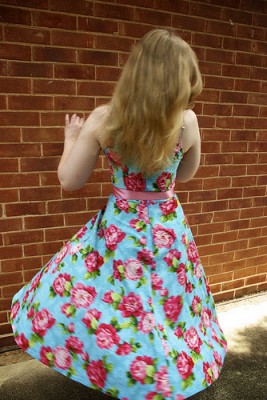
IMAGE A girl twirls in a pretty rose-print dress. IMAGE

Photo by erin_everlasting

If we’d started with the costuming, it is possible that the girl’s walk may be limited to the way the dancer feels inside the clothes. A swirly skirt could kill the audience’s chance to care about what this character is anticipating.

Dressing the Part

Soon we have a better understanding of “the girl” and we can glean a better sense of her personal style. Once we appreciate what she is anticipating, we can support her mission: a baseball game may indicate jeans or a uniform, a picnic with friends could be supported with capri pants and a button down. For a first kiss, she may don a simple dress.

Delivering the Message

The meaning driving these choices finally reflects more than “I liked it”. The uniqueness of the choreographer’s choices supports a true exchange of ideas, impressions, opinions, and perspectives. This is how choreographers and dancers develop their “eye” and start to interact more thoroughly with the world around them- a main mission in art-making.

This type of approach also invites the audience to engage in an experience that does more than scratch the surface. With more attention to how ideas are conveyed, as well as the exploration of more complex notions, we arrive at a place prepped for meaningful discourse and the development of a community’s aesthetic.

For additional discussion of the creative process, specifically costuming and critiquing, check out these articles:  The Art and Expectations of Performance Time and How to Write an Observation Paper or Critique.

How do you get students to focus on the creative process?

Tell us about a time when costuming altered or affected the intent of a piece or the way you danced in it.

Related Posts with Thumbnails
About Heather Vaughan-Southard

Heather Vaughan-Southard is a dance educator and freelance choreographer based in Michigan with rich teaching experiences in higher education, K-12 public schools, and private studios. With an approach of teaching dance as a liberal art, she draws from her experiences dancing professionally in Chicago, New York, and Los Angeles to create experiences that move beyond the boundaries of a studio, producing well-rounded, thinking dance citizens. She is author of the blog EducatingDancers, where she chronicles her perspectives on dance and dance education. Heather holds an MFA in Dance from the University of Michigan, BFA in dance from Western Michigan University, K-12 Dance Certification from Wayne State University and is the mother of two small children whom never seem to stop moving.

Comments

  1. Great post! We added black curtains to each of our studios so that we can have moments of covering the mirrors while also having students get the feeling of looking out and seeing ‘black’ – the view from onstage while dancing. We’ve found that this is more effective than turning their backs and not facing the mirrors. Actually looking out at black…Thanks for the tips on the costume blackout. Might be worth adding that into our mix too!

    • Heather says:

      Oh! I am equally excited about your black curtains! In the studio I am using now, I have two walls of mirrors and it is driving me a little crazy. I may have found someone to donate funds and had considered curtains for the mirrors…..I may just invest in black. Thanks for the idea!

  2. Erin Malley says:

    In some ways, I agree with you. It seems like a basic way of distilling dance down to its essence. Yet while dancers assume that black = neutral, it is an educated assumption. What about white? Can’t that also be neutral?

    Rarely is performance “neutral,” and I wonder if it should be addressed earlier on. We bring ourselves, as complex as we are, into our art making process. To try and erase who we are onstage can often leave our work awash in vagueness.

    In my own choreographic practice, I have been inspired by specific places, objects, costumes, texts and video designs – and integrate them into my work as essential elements. What if students were allowed to reverse their process, just once, and find out how limiting a costume piece can be…and still have to deal with it? I would encourage letting students try an alternative compositional method out early. Guided in a structured fashion, it is just as valid an approach and yield surprising results.

    • Heather says:

      Thanks for this thought provoking response. You bring up very good points.

      I think it is important to acknowledge where the students “are” in terms of what they’ve seen and experienced within dance. Many of my students have never attended a live show before performing in one. So while yes, white and other notions can be “neutral”, and are terrific food for theoretical thought, discussion, and exploration, I feel we need to find a way to engage them in a process before we can alter the process. It can be exciting to consider the potential to create without all of the traditional ideas to inform the outcome, but I don’t necessarily think that prepares students to succeed in other dance settings.

      I need to provide a context in a very practical sense, and that is how this concept arrived. We had just finished a performance that included “black-outs”, a feature that not all students had seen before having only seen recitals, and we all have access to black clothing.

      I am excited by the use of limitation- in many varieties- within the choreographic process and include them in my courses, including costuming. Yet, for the K-12 (and most studio) population, such abstract ideas regarding process can be overwhelming without a firm foundation in the standard theatrical conventions of making dance. I view them as the building blocks.

      As such, I choose to focus first and foremost on guiding students to authentically understand the *function* of concert dance.

      I love thinking outside the box and this is an ultimate goal for my students in my teaching. But before we get to that, we must first understand that the box is not simply a shape but is a container, filled with meaning and an intent to move.

      Thanks again, I really appreciate your response!

      • Heather says:

        Just a note- I realize many recitals do feature “black-outs”, it just so happened that one local studio apparently did not and that happened to be the show that a couple students had seen.

  3. Covering mirrors is a great idea. They have their purpose but can actually make it harder for dancers to ‘tranlate’ their movement sense to the stage. And I, too want to figure out how to transfer the costume blackout idea to a studio situation. It seems so often that the (natural) excitement over costumes can get out of control and become paramount to the dance in students’ minds. Would it have been an option, there definitely were years I’d have been tempted to withhold even thinking about costumes until students got their act together in class or on the choreography!

  4. I read every bit of your post and I loved it! I do believe that only if the dancers are exited with the dance they should wear a beautiful costume. I do not appreciate those who can’t dance wearing a blinding costume, one that doesn’t let you see past it, and when they are done dancing they feel good about themselves and look at the one in black down! Next time I dance I will wear black! In the past I worried about the costume almost as much as the dance, I worried about the dance though and I was dancing with some other great dancer including my sister and brother! My sister and I bought and made beautiful matching dresses, and spent countless hours embellishing them! But like I said our dance was we spent the most time on and we were good! Back to the costumes, as soon as we got to the places we danced people started looking, they knew we were there to dance seeing my sis and me wearing matching silver ruffle dresses with so much glitter and beads! Yet I think if you are wearing nothing but black leotards and pants you will have to convince the public to look at you with only the movements of your body and therefore you will work harder, I ask for permission to link your post on my blog!

    • Heather says:

      Thank you for your response! I am so pleased you found the article meaningful. Best of luck! You may consider contacting Nichelle for permission to link. I am not sure you need permission, but if so, she’s the person to contact.

Trackbacks

  1. [...] Here’s my latest for Dance Advantage! Share this:EmailFacebookTwitterLike this:LikeBe the first to like this post. [...]

Speak Your Mind

*

Spam Protection by WP-SpamFree