
About Shoe Reviews:
For my reviews, I personally wear, practice, and perform in the shoes. The demands that the shoes are subjected to are rigorous and must be considered when compared to the skill level for which the shoe is intended. ~ Tristan
Look for more tap shoe reviews in The Great Tap Shoeganza.
Capezio’s K360 (Brazilian)
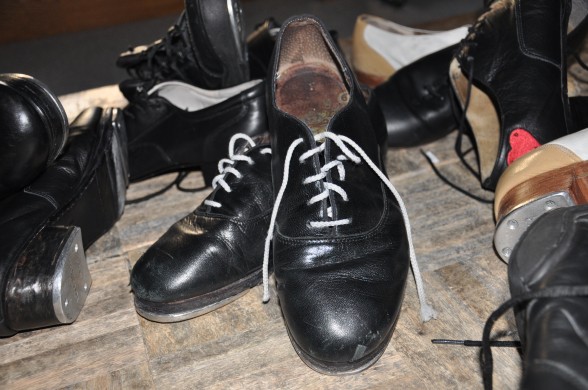
I chose to review the Brazilian-made K360 on the grounds that it is the shoe that the majority of professional and pre-professional dancers will buy. Costing roughly $200 and up, these are the shoes you are more likely to find on store shelves and on the internet.
The Capezio website directs buyers to Amazon.com to purchase their “Kays”, and the only make available on the site is the Brazilian-made K360. An American-made pair is only available through select retailers, like Dancing Fair, and if you are lucky enough to find one in a retail store, be prepared to dish out up to $400 for a pair (taps not included).
 VS
VS 
There is a heated debate among tap dancers concerning the Capezio K360 and where it is made. A dancer spends a good deal of time and money getting what is considered the Cadillac of tap shoes only to hear, “Oh, those are the Bazilians? I like the Americans much better.” Good luck getting them to tell you WHY they don’t like the shoe. I think and I heard are more than likely to accompany their lambasting lamentations.
I sat down with my tap shoe consultant, Matthew A. Shroepfer, to get the rundown on the actual differences between the Brazilian and American made Capezio K360.
Let’s take a look at the similarities:
Specifications for the Capezio K360 (from Capezio.com)
- Top quality kidskin upper. (Often shortened to kid, kidskin is a soft, supple leather made from the hide of young goats.)
- Hand stitched leather sole.
- Full leather lining assists with upper strength and over stretching.
- Non-slip heel counter.
- Paisley-print leather sock lining.
- Foam padding in the heel and arch area.
- 1″ stacked leather heel.
- Shoe can be customized, including building up the heel or sole, adding taps, suede or rubber, or changing the color of leather.
- Begin with street shoe size. (Women, 2 sizes down.)
Now the differences:
Assembly – The Brazilian-made K360 is indeed hand-made as the description states, though it is made using an assembly line-type process. A different person is responsible for each stage of the shoes’ construction. The American-made K360 is supposedly made using the same processes and machinery as the Brazilian version, but each pair is charged to an individual shoemaker. While the image of a handful of old, weathered shoemakers sitting in the basement of a high-rise in New York City cobbling shoes lends a quality of romanticism, it is easy to see how this old-world attention to care and detail could produce a higher quality tap shoe.
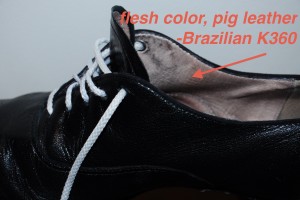
Inside Lining – The lining on the inside of the Brazilian K360 is made from pigskin, which lends a soft, comfortable feeling, especially to dancers who prefer to dance without socks. The American-made K360 uses cow skin for their lining, which, while rougher and more difficult to break in, provides a greater durability. The preference towards either material is subjective and dependent on a dancer’s personal tastes.
While the differences are few, they are indeed considerable, but how can you tell which pair of shoes is which?
The Paisley Printing – This is the easiest way of telling the difference. The signature paisley printing of the K360 can be found covering the entire inside of the American-made version, except for the counter (inside-back) of the shoe, whereas the Brazilian version only has the paisley print on the lining on the bottom of the inside of the shoe.
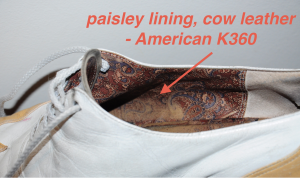
It Tells You – By lifting up the tongue of a Brazilian-made K360, you will see the gold embossed
words “MADE IN BRAZIL,” whereas the American version has “HANDCRAFTED BY BALLETMAKERS USA” printed above the counter of the shoe. Plus, if you flip over the Brazilian K360 you will find a shield-like stamp that contains the words “GENUINE LEATHER” inside it, along with “Since 1887” and your shoe size underneath it. The American K360 has no writing on the outsole of the shoe.$$$$ – Look at the price tag. ‘Nuff said.

It should be interesting to note that there are discrepancies pertaining to the quality of materials used in the Brazilian shoes’ construction and whether the machinery is indeed identical to their American counterparts. I have heard concerns from reputable sources, though a representative of the Brazilian factory has claimed that there is no difference in either materials or machinery. Until a more thorough investigation is conducted, I don’t feel confident in stating these claims as fact.
Capezio K360: Deconstructed
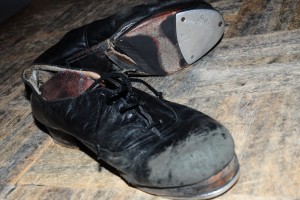
Kidskin upper, full leather lining, reinforced topline:
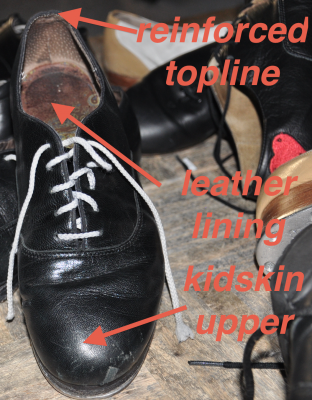 A unique feature of the K360 is the kidskin upper. The durability is decent and the leather is soft and pliable enough that after a moderate break-in time is allowed, the shoes should conform nicely to the feet.
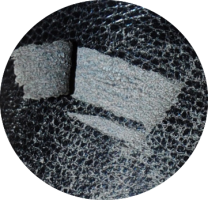
The leather will stretch over time, and though tear resistant, you will eventually find flayed strips of the shiny epidermis peeled away to reveal coarse and splotchy divots. If you have a little extra money laying around and/or prefer a more classic aesthetic, then a patent leather pair will not only look stylish, but aide in the longevity of the leather as well.
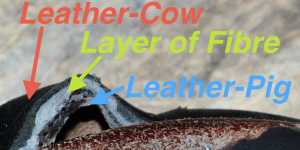 The layering of the leather is interesting; the polished, cow-hide outer layer and the pig-skin inner layer are separated by a soft, wool-like material. While providing an additional level of insulation, I am unclear if this is to aide the two layers in their suppleness, or to make the leather appear to be thicker.
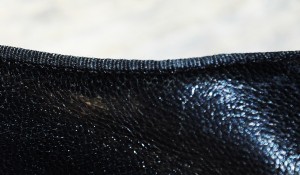 A thin strip of cloth that covers the topline of the shoe where the leather meets your ankle prevents tearing of the exposed edges of the quarters, the part that covers the instep of your foot. Extra binding also fortifies the back of the shoe where the quarters meet by covering up the stitching and aiding against splitting. Friction from rubbing against the material could cause irritation, though it covers such little surface area that I’ve never had a problem.
Paisley-print leather sock lining, non-slip heel counter, toe box and foam padding:
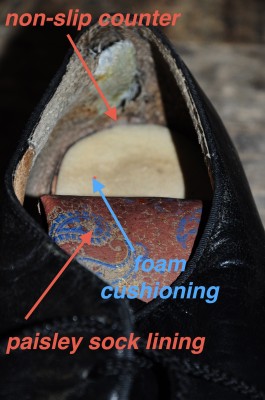
The paisley print is a dead giveaway for a K360, no matter its country of origin. With the Capezio name emblazoned in gold across its breadth, the lining covers up another distinctive feature of the K360, its Poron® foam padding.
The counter of the shoe and the front of the shoe are both fortified with a synthetic weave that acts as rigid support. In the toe box, the hard plastic web protects the front of the foot well, while the counter is sturdy enough to keep your foot solidly in place. These structures do deteriorate over time. While not as durable as a plastic insert, the reinforcing mesh in the counter will not bend out of shape or protrude from the leather, which can become very uncomfortable. As the toe box deteriorates, its protective qualities diminish, and in severe cases the peeling of the kidskin can become deep enough to reveal the unsightly white mesh material underneath.
Poron® is a microcellular strip of synthetic urethane that acts as an excellent cushion with outstanding durability and a long life span. Some dancers don’t care for the cushioning and will rip it out, complaining that it gets too cramped with certain specialized orthotics, or simply prefer a less squishy insole surface.
(Autographed by Dick Van Dyke)

Hand-stitched leather sole and stacked heel:
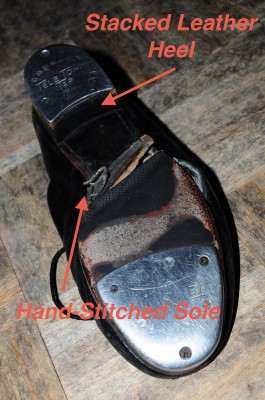
It is true that the leather upper is stitched well to the sole of the shoe, though I find that the sophomore signs of deterioration begin with a tearing around the leather that is stitched to the sole. The separated, thin strip of torn leather remains firmly intact and stitched down, for all the good it will do. I have had trouble with the sole of the shoe becoming too pliable, and I have even had the sole snap on a couple of pairs. However, it is the sole’s flexibility that makes it such an ideal tool for technical dancers, and it is up to the consumer if the Brazilian K360’s functionality outweighs its sole’s relatively short lifespan.
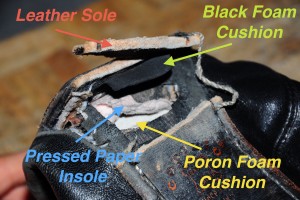 The sole itself is an amalgamation of materials. Underneath the paisley lining and the white Poron® padding lies an insole made of durable pressed fiber, which covers yet another thin layer of black foam padding, followed by the thick leather outsole. Featuring a more detailed design than lower level shoes, the K360 is a joy to dance in for long hours.
Customization:
You can get a K360 in almost any color that you can imagine. Most readily available are black, white, tan and (most recently) gold and silver. Other potential colors seem to cover the entire spectrum from magenta, to navy blue, to gunmetal.
The different sections of the shoe, consisting of both rear quarts as well as the vamp in the front, may contain different leather colors. There is even a wingtip-style K360 with a slightly different upper pattern that splits the vamp into two pieces, the flared or winged toe cap and the rest of the vamp, and divides the quarters into two large front sections and two small sections in the back… That comes to a total of 6 different colorable sections of the shoe!
Other customizations include the addition of a rubber pad or metatarsal bar behind the front toe tap, as well as the option of having the upper made of suede instead of the standard polished leather. Of course, the customized colors and additions will cost a little extra, and in the case of the suede, a lot extra.
Note: Keep in mind that taps are not included when purchasing the shoe from an average retailer.
(See more on tap shoe customizations: the taps, for fashion and function, and for health & comfort)
Final Considerations:
The Capezio K360 finds a good balance between being too comfortable and not comfortable enough; while the detailed construction ensures a comfortable fit, the weight and stiff sole maintain the supportive structure necessary for intense and demanding steps and technique.
Recently there has been great upheaval over the price of a pair of Brazilian AND American K360s, with the price of the Brazilian-made pair reaching over 300 dollars! And then an amazing thing happened… Other companies began releasing better quality shoes to compete with Capezio’s weakened stranglehold over the market. It used to be that the only shoes you saw on stage were K360s. Now you will find shoes with hearts on the side, shoes with intricate brogueing patterns, and highly fashionable shoes that are sure to make a tap dancer a real “triple threat.” Capezio’s response? The company not only recently brought down the price of the shoes back to their former cost, but have added the colors gold and silver and other small amenities at no extra charge.
By paying attention to the market and by listening to its customers, Capezio has garnered some redemption in the eyes of the tap community. While the initial price hike helped competitors wedge into the market, the Capezio K360 still retains the mantle of the king of tap shoes and the choice of professionals.
The Voice of the Consumer!
After reading this article you know the Capezio K360. You know what they are, where they came from and where they are going. Alas, I can only share my personal experiences with the shoes. If only there was some way to get into the heads of K360 users of different ages, backgrounds and skill levels.
Oh, wait… I can.

Original photos by Eamonn Sexton, who is on-call at several clubs in Chicago and is a contributor to Boi Magazine.
View Eamonn’s latest photos at Eamonn Sexton – Freelance Photographer
Do you dance in Kays? Tell us what you think in the comments!


Tristan Bruns has studied the art form of tap dance with Donna Johnson, Ted Levy, Lane Alexander and Martin “Tre” Dumas and has a BA in Music from Columbia College Chicago. Tristan has been an ensemble member of such Chicago tap companies as BAM!, The Cartier Collective and MADD Rhythms. Tristan currently produces his own work through his company, TapMan Productions, LLC, which includes the performance ensemble The Tapmen and the tap and guitar “band” of The Condescending Heroes.