
I sat on the front steps. I watched. The rain came down. The ground got soft. I stood up and jumped in the puddle. I went into the house with wet clothes.
Not such an exciting story. I gave you the events but not the texture, the details, the emotions, or the dynamics.
Let me try it again.
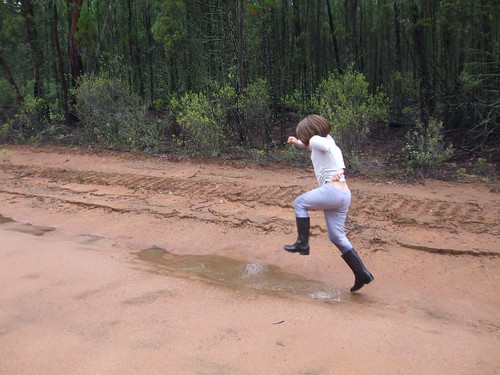
I sat on the front steps very still, searching the sky. I watched with excitement as the rain came down lightly as if greeting my cheeks with a familiar hello. The ground was soft and my boots sank ever so slightly as I stood up. And as I jumped with ease into the tiny puddle that was before me I thought of the spring showers I remembered as a child. I went into the house, haphazardly skipping from one puddle to another, giggling with my wet clothes hugging my body.
Or maybe the story went like this:

I sat bound to the front steps, my stomach tightened, feeling the darkening sky closing in on me. I watched with alertness as if danger approached. The rain came down like strong unrelenting tears. The ground got soft like it could not hold my weight. I sank deep into the thick mud as I stood up. With heavy feet I jumped into the closest puddle. I went into the house without looking back; my wet clothes drenched from the sky’s sadness.
These are two completely different stories with the same framework. What makes each one so different?
It’s the details.
This is how I see dynamics, which is an element of movement and I feel an element that deserves some much needed attention! Dynamics or in the world of Laban and Bartenieff otherwise known as efforts are broken down into weight, spatial focus, time and flow.
Weight: Light or Strong
The way we use our body’s weight can be light or strong. Think of weight in terms of force. How much force are you putting behind a gesture, or a leap? How much force do you use to lift a feather? Barely any. But a brick can take lots of effort, making you use a lot of strength or force. You can play around with weight by guiding a blindfolded person around the room. Do they like to feel a strong forceful touch or light touch?
Spatial Focus: Direct or Indirect
The next effort is spatial focus which can be direct or indirect. Direct is easy to understand. You want the cookie on the plate. You keep your eyes on the cookie, reach out in one distinct movement and take the cookie. You don’t meander around the room and wind up at the cookie a few minutes later. As for indirect, I once had a teacher describe indirect as a buzzing bee around your head. You swat at it, in no particular order or sequence and can never fully get a sense where it is at any moment.

Time: Quick or Sustained
Time is a fun effort because our own understanding of time changes as we age. It can be quick or sustained. My daughter lives in sustained time unless she wants to watch t.v. when I am on the phone. Then all I see in her body is quick. When I want her to get ready for school she puts on her clothes like she has all the time in the world. In fact it seems to me that she is not bound to any clock or time concept at all. This is sustained effort in a nut shell. As she is doing this I am pacing back and forth, peeking out the window for the bus and grabbing for her socks and sneakers. Absolute quickness!
Flow: Bound or Free
The last effort is flow which can be bound or free. Think of when a child is really angry. The child makes fists with their hands, tightens her belly and clenches her jaw. This is bound. Or think when a child has no care in the world and he is skipping around the jungle gym with ease. This is a perfect example of free energy.
Teaching Dynamics to Kids
How can you teach these concepts to children you might be wondering? Children experience these efforts in their bodies all the time. Just like you. It is becoming aware of them that is the challenge and the fun. I like to experiment with different efforts by getting in touch with emotions.
 How does your body like to move when you are happy?
Kids might say when there bodies like to skip or jump. If you pay attention to the quality, it will be light and free. I have never seen bound skipping!
How does your body like to move when you are angry?
I usually see fists, direct punching in the space, stomping, tight contracted shoulders. Again, the quality of movement is drastically different then free and light but they won’t be able to express it without some guidance from you. Try doing the same punching action with light and free qualities and she how the movement changes. Ask the kids if it is a movement from an angry body – they might say it is now a happy movement!
How does your body move when you are surprised?
How do you react when someone yells boo! You will see all the children do a quick movement. Usually when I get startled I flail my arms, very indirect! This brings on lots of giggles as they watch each other.
How do your body move when you are tired?
When you ask this question you might get bodies falling to the ground at first. The distinction is not how does your body move when it falls asleep but when your body is tired. Walk around the room jump, hop, and skip. The children’s movements will start to lack a sense of time and a specific spatial direction. It is amazing to watch the efforts change in the children’s bodies.
A great book that discusses effort into length is Primer for Movement Description Using Effort-Shape and Supplementary Concepts
by Cecily Dell. This book is invaluable to me. The explanations are thorough, detailed and easy to understand. This is one of my books that never spends too much time on the shelf.
I hope by breaking down the different dynamics or efforts it has helped you understand them in a new way, and will make teaching and experiencing effort in your classes or with your children very accessible to you. Remember, dynamics help texture movement stories. Like the story I told in the beginning, when you change the dynamics, the entire mood, feeling and emotion changes. The meaning of the story changes as well. Just like the meaning of a gesture will change when you simply replace bound effort with free!
![Reblog this post [with Zemanta]](https://img.zemanta.com/reblog_e.png?x-id=9915eb5b-79e6-44c9-91ff-5a5e5b5fa58f)


Stacey Pepper Schwartz is the Founder and Director of Leaping Legs Creative Movement Programs. The focus of Leaping Legs is to help people regardless of age, experience or ability, become educated about their movement potential, develop kinesthetic awareness, and become more physically fit and healthy together as a family, and community. Leaping Legs promotes its goal through its original Up Down & All Around DVD, teacher training, and school and community workshops. The Up Down & All Around DVD received Dr. Toy’s 100 Best Children’s Products 2009 Award and 10 Best Active Products 2009 Award. The DVD has also been featured in many magazines including Dance Teacher and Dance Retailer News. In its August 2009 issue, Dance Teacher called the DVD “an essential tool for teaching the fundamentals of movement with daily adult-child interactions.” Come visit www.leapinglegs.com to learn more about Stacey and her programs.