
 Parents, whether you have had experience with dance or not, it is natural to wonder about how your little dancer will do in dance class for the first time. This is especially true if dance class is the first time your preschool child will be separated from you for a structured activity.
We hope the following will give you an idea what to expect of your child as they take this step toward independence.
Jumping In
The initial days and weeks of dance class can be quite overwhelming for a child new to dance. The new environment and unfamiliar faces can be frightening at first.
While some children jump right in with both feet, many children take a more cautious approach, using the first few classes to watch or participate minimally. Taking time to warm-up in this new situation is quite normal. In fact, children may take several weeks to feel comfortable in dance class. Don’t worry, they are still watching and learning during this phase.
Gentle encouragement may help shy or frightened children adjust but most will be ready to participate after a session or two. Few kids are willing to miss out on the fun for very long.
“Don’t Go!!”
Young children, when feeling insecure may insist (through body language, tears, or words) that they feel safer with a parent in the room.
It may be hard for you to resist prolonging or avoiding departure to comfort your child or avoid tantrums. At first, the goodbye is the hardest part for both parent and child. Many children who cry and become distressed when a parent leaves, quickly recover once the class has begun. You can help to ease your child’s separation anxiety with the help of teachers who know how to conquer first day jitters.
Children in dance classes often have a tough time concentrating and fully engaging in class when parents are present. Some kids become shy in the presence of unfamiliar faces. Others simply can’t resist running back and forth between class and their own parent. And a few are likely to “show-off” for an attentive audience.
As a teacher who is also a mother, I feel strongly that parents have a right to observe classes. Many dance schools offer alternatives to sitting-in so that parents may regularly view classes.
Observation Options
Unobtrusive opportunities to view your dancer in action include one-way mirrors, viewing windows, and video monitors. Video surveillance cameras allow parents to observe the overall safety of the child and see a bit of what they’re working on without distracting the students and teacher.
Clear windows work for older students but younger students easily become distracted by any and all activity outside. Even one-way windows and mirrors are not totally distraction-free because students can become extremely curious about what they know must be going on outside. Plus, people on either side are likely to touch, bump, or tap on a window/mirror within reach. Resist the urge to tap on windows or enter the studio when your child is not behaving in a way you expect. Let the dance teacher handle it.
Parent conversations about what’s going on in class are inevitable. For the sake of everyone, it’s important that parents keep their chatter positive while observing from the lobby waiting area.
Scheduled observation days throughout the year may also used to share progress with you and prepare children for performance. These mini-events help children learn to be attentive and productive in class even while you quietly view from the sidelines.
The first few weeks of class are not the time to sit-in and observe. This time must be spent establishing the routine and structure of the dance class and building the teacher’s authority and expectations in regard to the dancers.
If you want to see a teacher in action to make sure the class is right for you, the best time to do this is prior to the start of the class/season. If this opportunity is not advertised by the studio, just ask how or when you might observe a class before registering or enrolling.
Parent Involvement
Teachers may encourage parents to come early before their child’s first day of class (or at some other designated time) to look quietly around the studio and say hello to their teacher.
This helps the child to become familiar with their class environment and is just one of the ways you might be enlisted to help smooth your child’s transition into a new class. Here are some other ideas:
- Ask him/her to become the teacher at home, instructing you or even siblings on what he learns in class each day.
- Make a ritual of providing hugs and kisses before and after class
- Offer to have a special toy or stuffed animal be a stand-in until class is over
- Put together a special dancer’s outfit or accessory that will make the child feel stronger or perform better in class.
Children can even have a say in the matter. Ask them what might help them to feel more secure even though Mommy or Daddy cannot be with them for this short time.
Parent involvement is beneficial to the students and teachers and reassures you that your role is an important one.
Dance of Independence
As important as you are to the development and learning of your children, as they grow, kids also benefit from time apart from parents. They gain confidence in their ability to make choices, learn new things, form and share their own ideas.
As you witness these developments you will learn to value and enjoy your child’s dance of independence, watching as s/he learns to appreciate dancing with and without you.
Trust that a good dance school will take great care in helping their youngest students adjust, provide a solid foundation in movement and technique, and establish strong communication with parents.
Working together, parents and teachers can give young dancers a great start to a long and positive future in dance.
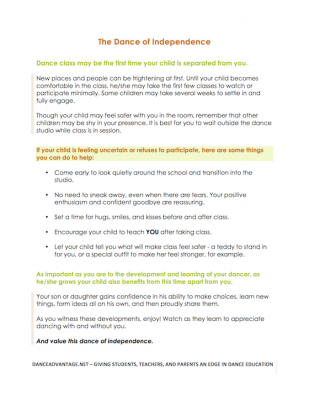
Download the document below and share it with other dance moms and dads!


Nichelle Suzanne is a writer specializing in dance and online content. She is also a dance instructor with over 20 years experience teaching in dance studios, community programs, and colleges. She began Dance Advantage in 2008, equipped with a passion for movement education and an intuitive sense that a blog could bring dancers together. As a Houston-based dance writer, Nichelle covers dance performance for Dance Source Houston, Arts+Culture Texas, and other publications. She is a leader in social media within the dance community and has presented on blogging for dance organizations, including Dance/USA. Nichelle provides web consulting and writing services for dancers, dance schools and studios, and those beyond the dance world. Read Nichelle’s posts.